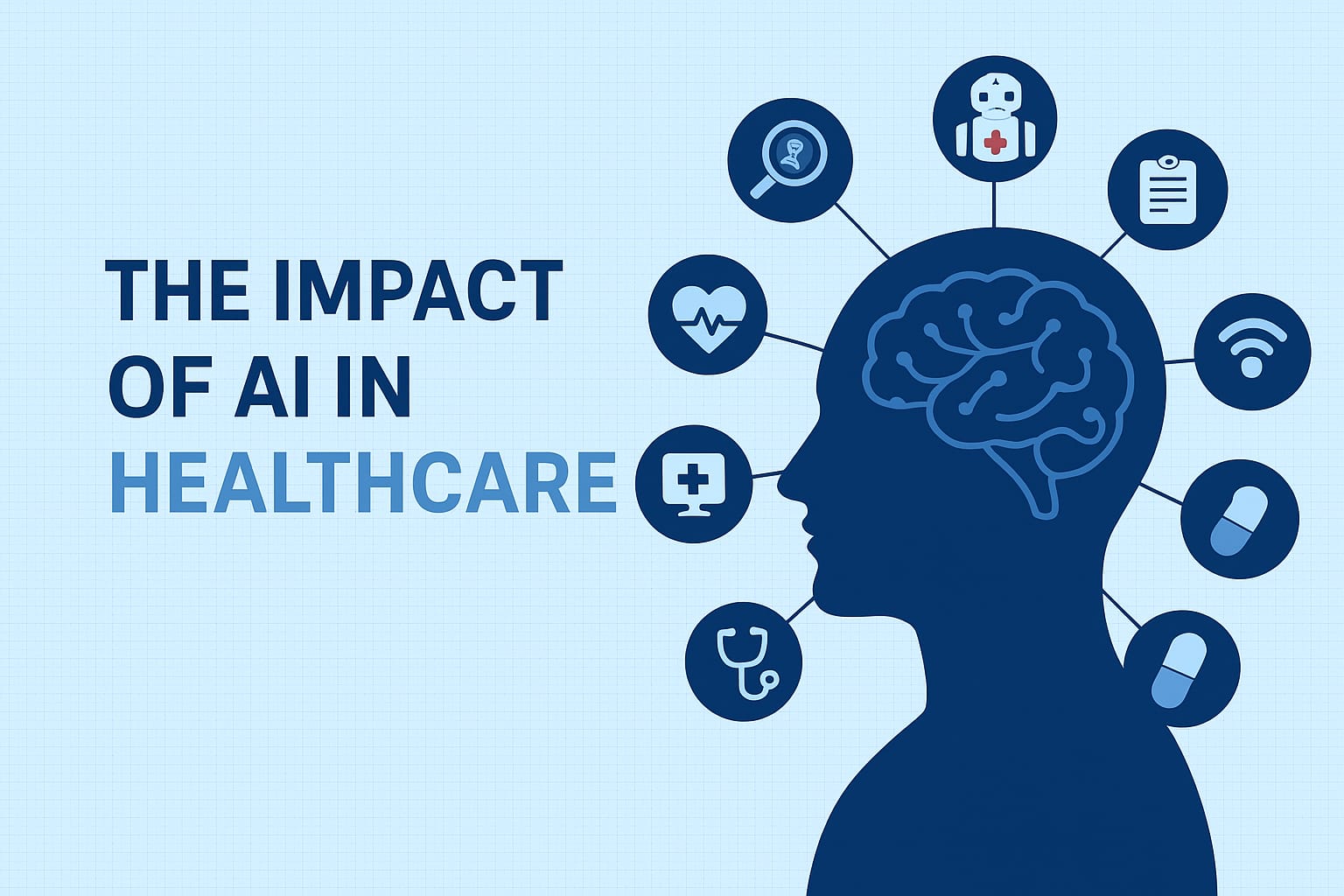
Artificial Intelligence is not just transforming healthcare — it is reshaping the entire ecosystem around it. From hospitals to insurance companies, pharmaceuticals to diagnostics, and even rural health delivery, AI is making care faster, more accurate, more accessible, and more affordable.
Here is a comprehensive view of how AI is influencing the healthcare sector today.
1. AI in Diagnostics: Faster, More Accurate, More Reliable
One of the biggest revolutions is in diagnostics.
AI systems can now:
Detect cancers (breast, lung, skin) from images earlier than human radiologists
Identify diabetic retinopathy with near-perfect accuracy
Predict heart attacks based on ECG patterns
Detect pneumonia from chest X-rays
Identify rare diseases from symptoms + genetic dat
Impact:
✔ Faster diagnosis
✔ Lower cost per test
✔ Earlier detection → better survival rates
✔ Reduced workload on specialists
This is critical in countries like India, where specialist availability is uneven.
2. AI in Medical Imaging & Radiology
Radiology is one of the first domains to experience deep AI disruption.
AI tools can:
Read X-rays, MRIs, CT scans
Highlight problem areas for doctors
Reduce human error
Speed up scan reports from hours to minutes
AI does not replace radiologists — it makes them superhuman.
Impact:
✔ Higher accuracy
✔ Faster reporting
✔ Reduced burnout
✔ More patients served per doctor
3. AI in Drug Discovery & Pharma R&D
Drug discovery normally takes 10–12 years and billions of dollars.
AI has changed that.
AI can:
Identify molecules faster
Predict how a drug will react in the human body
Shortlist the best drug candidates
Simulate clinical trials
Reduce R&D costs
Companies like DeepMind, Insilico Medicine, Moderna, and many others are already using AI to design new drugs.
Impact:
✔ Faster drug development
✔ Reduced cost
✔ Higher success rate
✔ Ability to respond to pandemics quickly
4. AI in Hospitals: Improving Efficiency and Reducing Costs
Hospitals use AI for:
Appointment scheduling
Bed management
Predicting emergency room load
Managing inventory
Handling insurance paperwork
Automating billing
Many hospitals are deploying AI medical scribes that listen to doctor–patient conversations and automatically generate case notes.
Impact:
✔ Time savings for doctors
✔ Better hospital operations
✔ Lower admin costs
✔ Less waiting time for patients
5. AI in Personalized Medicine
Every patient is different.
AI helps craft personal treatment plans for:
Cancer
Diabetes
Heart disease
Genetic conditions
AI uses health records, genetic data, lifestyle patterns, and medication history to design customized treatments.
Impact:
✔ More effective treatments
✔ Fewer side effects
✔ Better long-term outcomes
6. AI in Telemedicine & Remote Care
AI chatbots and virtual health assistants serve as the first point of medical contact:
Symptom evaluation
Basic medical guidance
Medication reminders
Follow-up care
Emergency triage
Wearables + AI can detect:
Irregular heartbeat
Sleep problems
Stress levels
Blood oxygen drops
Early diabetes symptoms
Falls in elderly patients
Impact:
✔ Healthcare access in rural areas
✔ Reduced hospital visits
✔ Early alerts for at-risk individuals
✔ Continuous patient monitoring
7. AI in Mental Health
Mental health apps powered by AI provide:
Therapy-style conversations
Early detection of depression/anxiety
Mood tracking
Immediate support in crisis situations
These tools make mental health support available 24/7 — especially useful in countries with low therapist availability.
Impact:
✔ Early intervention
✔ Reduced stigma
✔ Wide accessibility
✔ Personalized mental health support
8. AI in Health Insurance & Claims Processing
Insurance companies use AI for:
Fraud detection
Faster claim approvals
Risk assessment
Personalized premiums
Predicting hospitalization costs
Chatbots handle customer queries, increasing efficiency and reducing manpower costs.
Impact:
✔ Faster claims
✔ Lower fraud
✔ Fairer pricing
✔ Better customer experience
9. AI in Medical Robotics & Surgery
AI-assisted robots perform surgeries with:
High precision
Minimal invasion
Faster recovery time
Lower infection risk
Robotic surgery is now widely used in:
Orthopedics
Cardiology
Oncology
Urology
Gynecology
Impact:
✔ Higher surgical accuracy
✔ Shorter hospital stay
✔ Reduced complications
10. AI in Public Health & Epidemiology
AI helps governments and NGOs:
Track disease outbreaks
Predict future waves
Plan vaccination campaigns
Analyze health data
Create resource distribution models
This was extremely useful during the COVID-19 pandemic.
Impact:
✔ Smarter public health decisions
✔ Better preparedness
✔ Data-driven policymaking
Overall Impact: AI Is Making Healthcare…
✔ More Accurate
Better diagnostics, early detection.
✔ More Accessible
Telemedicine and chatbots.
✔ More Affordable
Lower cost of tests, automation of admin tasks.
✔ More Predictive
AI can forecast diseases before symptoms appear.
✔ More Personalized
Treatment tailored to every individual.